Thursday, 16 July 2015

Culburra Beach Hemp House

Photo: Nathan Devine


Location:
Culburra Beach, NSW South Coast

Type of Build:
Single storey detached residence.

Owner:
Kirstie  Wulf and Ben Schueler

Designer:
Kirstie Wulf, Shelter Building Design

Builder:
Owner builder

Size :
123m2  building, 55m2 decks

Cost:
$210,000

Date of construction:
April 2012 - January 2015

Purpose of Build:
To provide a comfortable, natural, low energy holiday home with room for guests.

Choice of Material:
Kirstie was looking into natural building materials suitable for construction by an owner builder. She was investigating light earth (also known as light clay straw) when she found an article in Owner Builder magazine on hemp and liked the materials combination of insulation and thermal mass, the   

Climate:
Zone 6 – Mild Temperate

Local Council:
Shoalhaven Council

Obtaining Approval:
Although Shoalhaven Council had not come across hemp walls before the Council did not have an issue with them, but was quite picky about the wording of the Engineer’s report on the hemp walls and how it referred to the specific sections of the BCA. This held up Council approval by a few months. Council inspectors had no issue with the build during construction.

Construction:
The build was carried out by Kirstie and Ben as owner builders. The excavation, concrete slab, frame and frame erection, roof and plumbing and electrical were contracted out and Kirstie and Ben and generous friends constructed the walls and the internals and fit out. 

Footings:
Waffle Pod concrete slab on ground.  

Floor:
Polished concrete slab. The slab had 3% onyx oxide added making it a very dark grey. The top of the slab was lightly ground back to expose the mixed river stone in the slab in a “salt and pepper” look. Ceramic tiles were used in the bathrooms and laundry.

Frame:
Made off site by Truss-T –Frames at Bellambi, near Wollongong. The frame was erected by local builder, Rob Cheadle.

Walls:
200mm hemp masonry walls externally, constructed using AHMC binder, cast around a centrally placed 90mm structural pine frame. 10mm of AHMC hemp/lime render inside and out. Internal walls Magnesium oxide board finished with

Under construction
Windows:
Rylock thermally improved aluminium double glazed sliding doors and windows. Temporary formwork only used around windows and doors. External window reveals were rendered and sealed to the window with colour matched Sikaflex. Internally the Rylock windows came with an attached timber reveal. The revel was sized and the windows placed so that the render finished flush with the timber window reveal, avoiding the need for further trim and creating a minimalist look.

Ceiling:
Raked ceilings using hoop pine plywood, left unfinished with a 9mm black shadowline between sheets.  Higgins sheep’s wool insulation installed between rafters, R3.5 in kitchen/living/dining room and R3 in bedrooms and bathroom. Air cell R1.5 combined sarking, reflective foil and insulation installed on top of rafters under roof sheeting.

Main living / dining / kitchen area     Photo: Nathan Devine
Roof:
Colorbond custom orb (corrugated profile) in shale grey.

Heating:
 A gas bayonette has been installed but due to the house’s solar passive design and good insulation, to date the house has not required any heating in winter. 

Cooling:
Natural ventilation only. Doors and windows were placed to catch summer afternoon sea breezes and are left open on summer nights to cool down the thermal mass in the concrete slab.
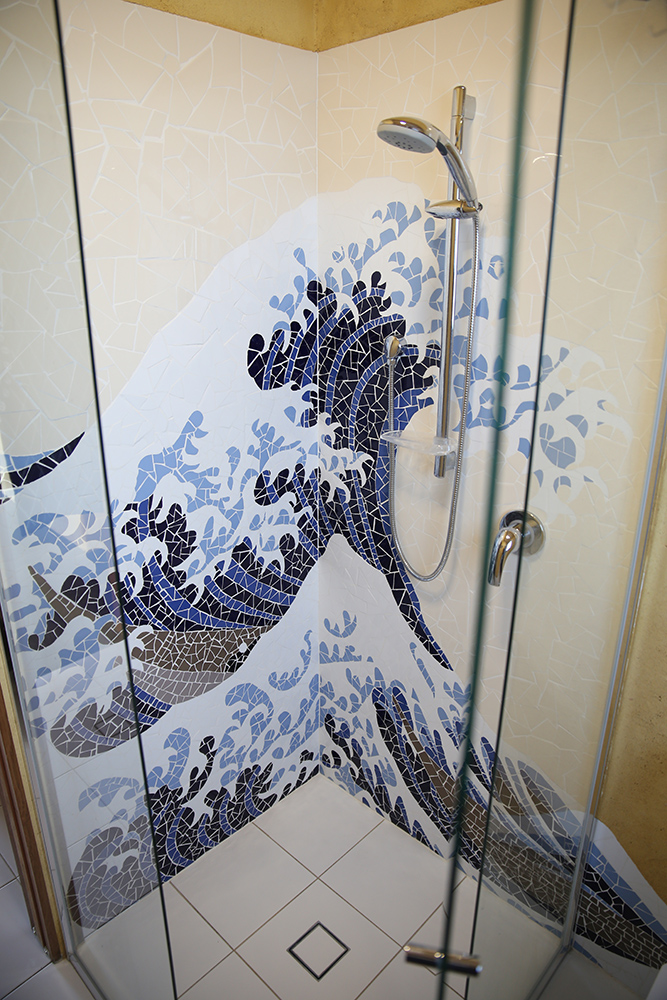
Mosaic shower
Wall construction:
Kirstie attended a hemp building workshop with Klara Maroszekky from the AHMC and a workshop with Steve Allin (from Ireland) prior to commencing the build. The workshops both focussed on the mixing and placing of the hemp material, but lacked information on construction detailing to be used with hemp walls. 

Formwork:
OSB (oriented strand board) recycled from large packing crates, was used as formwork. The formwork was temporarily attached to the frame with coach bolts and spacers made from rigid conduit. The spacer holes were filled with hemp mix after the formwork was removed.

Section Diagram:
Technical issues:
Hemping up under the rafters was awkward but not impossible. Challenges were also faced with placing formwork and hemp in to small spaces, particularly in an area between two roofs. The frame had been constructed without any direction to the frame builders apart from the specification of 600mm centres for the studs. In a number of locations the presence of triple studs, particularly next to doors, meant that the hemp had nothing to key into and in some spots it pulled away from the frame as it dried. This was resolved by placing crews with large plastic washers through the wall into the frame pulling the hemp wall back to the frame. Dealing with long and thick lintels over large windows also posed some challenges, which with hindsight could have been avoided by using permanent formwork, but such a decision needed to have been made prior to the manufacture of the frame to allow for the extra thickness in the openings of the permanent formwork. Difficulties were also experienced with the application of the render, particularly on the MgO board. 

Advice/Recommendations:
In the design of the house the ease and ability to make the hemp walls needs to be taken into consideration. Similarly the house frame needs to be designed to work with the need for the hemp walls to key in around the frame. It is recommended to test several renders and colours before committing to a particular render.

Contact:
Kirstie Wulf


Thursday, 9 July 2015

Kyneton Hemp Bed and Breakfast


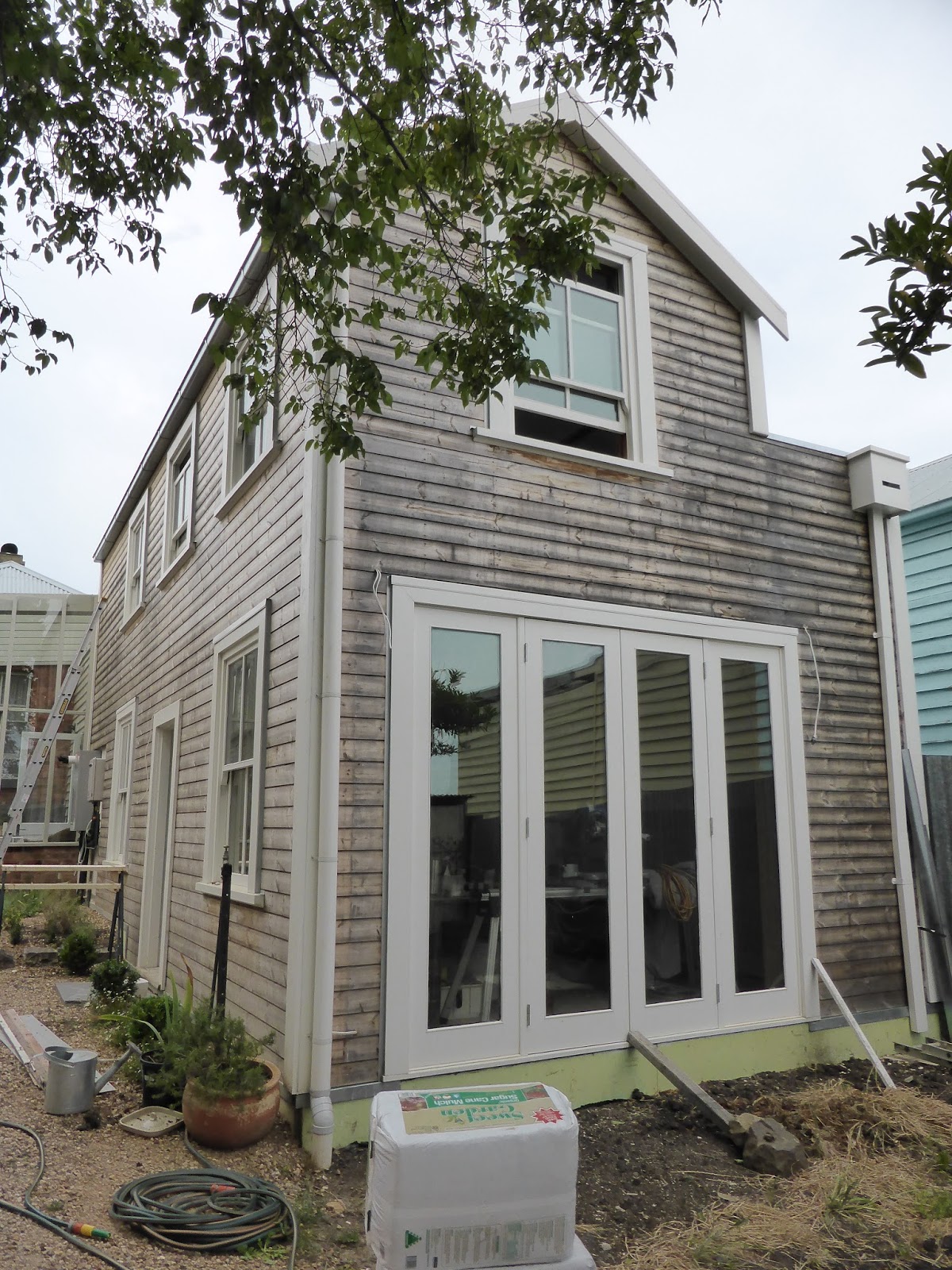
Rear view of studio
Location:
Kyneton, Victoria

Type of Build:
Two storey studio in heritage listed area, attached to rear of existing building.

Owner:
Joe and Deb D’Alo

Designer:
Ian Murray, Joe D’Alo and Deborah Varney

Builder:
Joe D’Alo

Size :
67.5m2  total; 40.5m2 downstairs and 27m2 upstairs.

Cost:
$165,000

Date of construction:
January 2012 to lock up stage in 4 months.  As a July 2014, still not finished, will need a further 2 months to complete

Purpose of Build:
To provide separate guest accommodation to be used as a Bed and Breakfast.  A unique experience for guests to stay in a hemp cottage.

Choice of Material:
Joe and Deb had been following the development of hemp construction for about 15 years. They have an interest in natural building and Joe had worked on both rammed earth and strawbale buildings. He saw the flaws with each of these construction types, such as the thickness of the walls for a strawbale building. Joe saw hemp construction as addressing some of the disadvantages of these other natural building methods, so with hemp also providing a combination of thermal mass and insulation, the choice of hemp for his own build was obvious. Hemp is an ideal building material for the climate in the region, as it has good thermal insulation whilst still providing some thermal mass for energy storage.

Timber rain screen finish
Climate:
Zone 7 – Cool Temperate

Local Council:
Macedon Ranges  Council

Obtaining Approval:
Council approval was granted for this build in a heritage area. A private certifier/building surveyor was used and there were no particular issues with the hemp construction.

Construction:
The whole build was carried out by Joe D’Alo who is a licensed builder. A carpenter with concrete formwork experience was employed. There was also a team for the hemp-lime mixing, filling the formwork and tamping.

Footings:
Concrete slab on ground. Concrete slab is a thickened edge raft slab with internal beams and expanded polystyrene edge insulation.

Floor:
The ground floor is tiles over concrete slab.  Upper storey – Alpaca carpet in bedroom and tiled bathroom. 

Frame:
Joe made the timber frame on site.

Walls:
Joe made the timber frame on site, using Australian Hemp Masonry Company (AHMC) binder, cast around 90mm structural pine frame. Internal walls were finished with a first coat of AHMC Binder and sand and a second coat of Plastalite lime/gypsum plaster. External walls were clad with Spruce Thermowood, which was left to naturally grey. For the external walls 25mm timber battens were fixed over the 10mm permanent magnesium oxide (MgO) boarding then clad with Spruce Thermowood weatherboards.  The 25mm gap between the MgO board and cladding creates an insulating layer.

Inside ground floor
Windows:
Double hung, double glazed timber windows. Permanent formwork was installed around the windows and doors.

Ceiling:
The exposed 20mm Supaboard Magnesium Oxide board floor of the upper storey acts as the ceiling to the ground floor.  Upper storey ceiling is 10mm Supaboard Magnesium Oxide board which was stopped and finished in a similar fashion as standard gyprock plaster then painted with a breathable paint. 250mm of “light hemp” (hemp wall material with less binder and no sand) was cast over the Magnesium oxide board as ceiling insulation.

Roof:
Corrugated galvanised metal sheet roofing is used.

Heating:
 A wood heater is planned to be used in an old fireplace, but Joe and Deb have found that the building stays warm in winter without heating.

Cooling:
The building uses only natural ventilation. Joe and Deb found that on a 40o C day the downstairs of the studio stayed a much more comfortable 25 – 26o C.

Upstairs under construction
Wall construction:
Joe is a licensed builder and carried out the wall construction himself, using a 360 litre diesel pan mixer hired from AHMC. Prior to construction Joe attended a Hempcrete workshop in Maleney, Queensland, but found the course lacked detail particularly when it came to how to specifically deal with window and door openings.

Formwork:
Magnesium oxide board was used as a permanent formwork on the external side of the wall. Formply was used for the internal formwork and rather than being attached to the frame it was braced against a timber stud on the floor so that there were no holes in the hemp wall. 

Section Diagram: 


Technical issues:
Hemping between the exposed upper floor joists was difficult. The 35o ceiling was fine to work with but the 47o ceiling was too steep and was awkward to build. Joe recommends that those interested in hemp building need to think about how to deal with window and door opening, in terms of lintels, flashing and how the render is to join the timber (window or door) frames.

Advice/Recommendations:
Joe found that using an external cladding and permanent formwork on one side of the hemp wall made the walls quick and easy to go up, because you only have to raise the formwork on one side, rather than both.  Although Formply was used as the formwork board, ply or OSB would have been quite suitable and cheaper. The external cladding was also advantageous from the point that the timber weatherboard cladding used maintained the look of the other outbuildings.  A rendered wall may have looked out of place.
Joe recommends runing electricals through conduit through the hemp walls. The mixing and tamping of the hemp-lime material is initially fun and therapeutic, however things can quickly change and the process can become a long and arduous task which will test people’s spirit.  A large, trained team might cost more in direct labour but the benefit will be in getting the hemp walls constructed quicker thus allowing them to dry (up to 6 weeks) before rendering.  The timing may be of particular importance if seasonal weather conditions are extreme.  Hemp lime building shouldn’t be undertaken when seasonal conditions are extreme, i.e., frost.

Contact:
Joe D’Alo
joe.dalo@bigpond.com

Thursday, 25 June 2015

Kensington Hemp Extension

Under construction

Location:
Kensington, Melbourne, Victoria

Type of Build:
Extension and separate workshop

Owner:
Grant Randle and Shelley Hosking

Designer:
Barbara Weimar Architect

Builder:
Grant Randle - Owner Builder

Size:
80 sq. new;  total 115 sq. including retrofit of part of existing house; plus 15 sq. workshop/brewery

Cost:
$430,000 (est)

Date of construction:
Commenced: September 2014

Purpose of Build:
To provide a new kitchen, dining and living room and a link, between the old weatherboard home and the new extension, containing a music room. The design uses high windows to bring northern light into the extension which is to the south of the existing building.

Choice of Material:
Grant and Shelley wanted to use a zero carbon material in their extension and researched several alternatives including using straw bale, but straw bale would have meant thick walls, taking up valuable floor space on an inner city site. As well as choosing to build with hemp for the walls and as the ceiling insulation Grant and Shelley have chosen to use other low carbon, natural materials, choosing timber frame and beams over steel. Grant and Shelley came across hemp building while researching sustainable design on the internet. They chose hemp for its thermal effusivity resulting from the unique combination of thermal mass, thermal resistance and moisture absorption properties. They were also attracted to the simplicity of the basic materials, the robustness compared with strawbale and the possibility to self build with limited skills.

Inside under construction
Climate:
Zone 6 - Mild Temperate

Local Council:
Melbourne City Council

Obtaining Approval:
The building application was initially lodged with a drawing note referencing HCA (Hempcrete Australia) material “installed as per manufacturer’s recommendations”. It did not explicitly mention the NCC approval. When the binder was changed to the Australian Hemp Masonry Company (AHMC) binder, an engineers report was provided to the private building surveyor. Melbourne City council had no issues with the hemp walls during the planning approval stage and the building surveyor has had no concerns to date.

Construction:
The walls, insulation, MgO Board walls and kitchen installation are being carried out by the owner. A builder was contracted to do the concrete slab, timber frame and roof.

Footings:
Concrete raft slab on ground with expanded clay aggregate balls (Clinka) underneath and EPS (expanded polystyrene) around slab edge to achieve an R1.8 rating for the entire slab.

Floor:
Polished concrete in living and dining room; Cork and linoleum in kitchen.

Walls:
300mm hemp walls, using Australian Hemp Masonry Company (AHMC) binder, cast around 90mm pine frame. Render to be decided.

Windows:
European Timber Windows, triple glazed in the highlights and double glazed elsewhere.

Ceiling:
10mm Magnesium Oxide board on timber battens at 450mm centres, with hemp insulation 150mm thick, using an AHMC ceiling mix of 5.5kg of hemp to 4.5kg lime, and no sand.

Hemp/lime as ceiling insulation. Photo:Shelley Hosking
Roof:
Corrugate Zincalum with silver batts mounted under rafters to provide a thermal siphon effect to limit thermal load from the attic. Pitched roof chosen to provide solar panel mounting without an ugly frame, easier hemp placement at the top of the wall and thermal barrier between roof and ceiling.

Heating:
Wall mounted hydronic heating.

Cooling:
Passive ventilation. Design includes high opening windows to assist with ventilation.

Wall construction:
Grant and Shelley, with family and helpers built the walls using a 120 litre pan mixer purchased from through e-bay. Prior to commencing construction Grant and Shelley had attended a 3 day hemp building workshop with Hempcrete.

Formwork:
Geoplast plastic formwork and OSB (oriented strand board) reinforced external with timber. The 6mm OSB is not stiff enough for formwork on its own. Grant and Shelley only used the 6mm OSB as they inadvertently received it with the frame for bracing. The sheet bracing was replaced with steel strap, and the surplus used as formwork. They have also purchased some concreter’s form ply for formwork.  

Geoplast and OSB formwork
Section Diagram:


Technical issues:
Grant and Shelley found it difficult to get information on hemp building.

Advice/Recommendations:
If using plastic formwork design the house to fit the formwork. Try to avoid double and triple studs in the timber frame by adding timber spacers between the studs.
For the big lintels and beams where they only had 50mm cover, they used permanent formwork of wood wool board from Knauf (Heradesign), rather than risk the hemp falling off.
For window and door openings, Grant and Shelley suggest extending lintels 300mm past the opening so that supporting double and triple studs can be fully encased in hemp.
They also suggest using timber bracing a they had in a workshop they attended..
For more helpful tips see Grant and Shelley’s blog below.

Contact:
Read more about Grant and Shelley’s hemp build at hempcretehome.blogspot.com

Saturday, 21 March 2015

Sharing Natural Building Information

Building with hemp


Hemp building is relatively new in Australia as are many other natural building techniques such as light earth and earth bag construction. This project has therefore been set up to share the techniques and experiences of those building with hemp and other natural building products.


The purpose of this  project is to focus on the use of hemp and other natural building materials, not as isolated components, but in the context of how they fit with the overall building and approval process.

A range of buildings will be reviewed with the same information provided about each building project. Some buildings reviewed as part of this project are still under construction an it is planned to revisit these buildings upon completion and provide further updates.

The review of each building will look at a range of issues including the type and size of buildings being constructed, the climate they are being built in, the method of construction used and how the walling method intersects with other building materials. For each build there will be a diagrammatic section through the building showing how the walls join to the roof, windows and footings. Issues such as Council approval will also be addressed.

The building materials used do not dictate the design of a building and this project will demonstrate the variety of building styles that hemp can take as well as the various different construction methods in which it can be used.

About the author:
Kirstie Wulf is a Building Designer and principal of Shelter Building Design. She holds a Diploma in Building Design,  and a Cert IV in Architectural Technology, for which she won the State Medal. Kirstie has a strong interest in natural building and has constructed her own hemp house as owner builder, she has also worked on projects using mudbrick, cob, light earth and strawbale.